
Share Robert Edward Scruggs's obituary with others.
Invite friends and family to read the obituary and add memories.
Stay updated
We'll notify you when service details or new memories are added.
You're now following this obituary
We'll email you when there are updates.
Select your format and elements to print

IN LOVING MEMORY OF Robert Edward Scruggs
Robert Edward
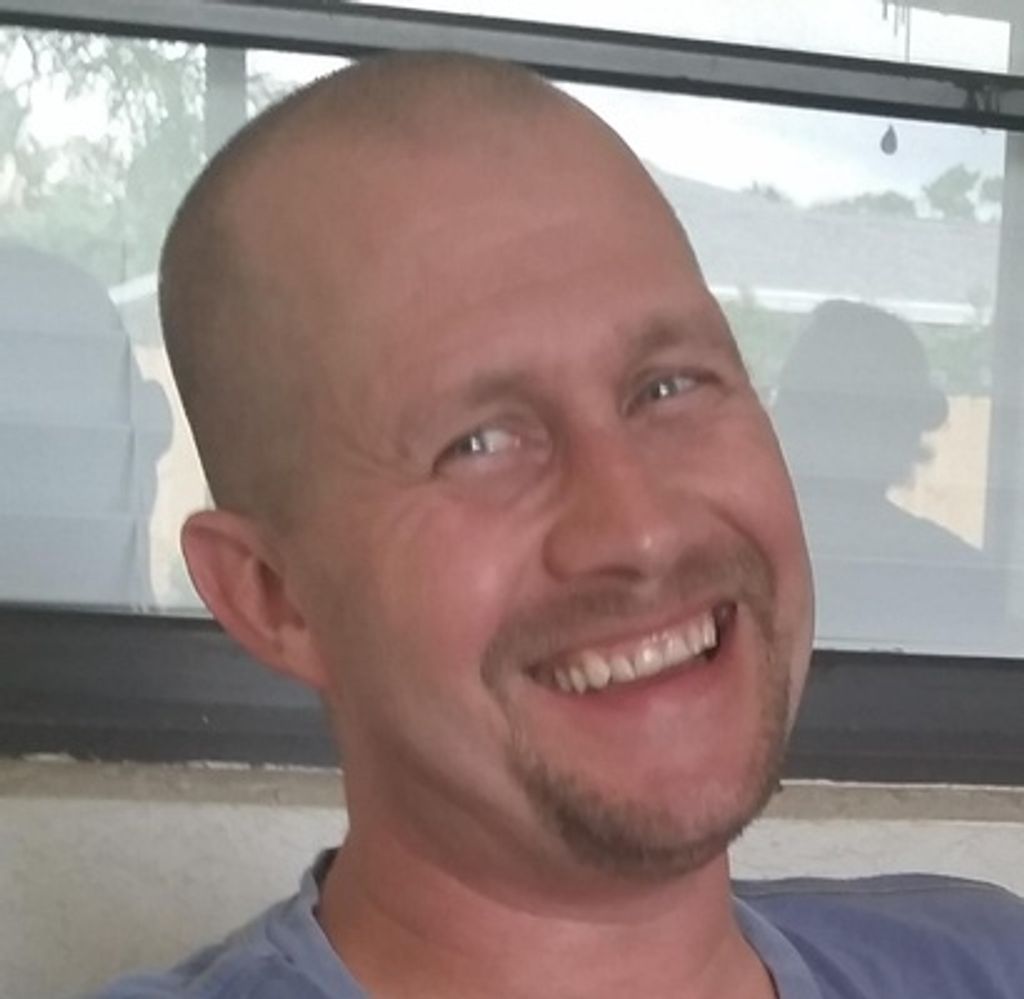
Scruggs
Dec 28, 1970 — Mar 30, 2018
Port Saint Lucie
Robert Edward Scruggs' Obituary
Robert Edward Scruggs, a much beloved father, son, uncle, grandson, nephew and friend, went to be with Our Lord on Good Friday morning, March 30th, 2018. He was an Army Staff Sergeant, medically retired in June 2014 after serving for just under 15 years. He was 47 yrs old. He was deployed to Iraq where he received his initial injuries.
Bob is survived by his sons, Aiden T. Scruggs & Cyrus D. Scruggs; his parents, Bob & Carol Scruggs; grandmother, Doris Nemeth; sister & brother-in-law: Christine & Dennis Greehy; aunts & uncles: Barbara Slayton, Edward & Denise Nemeth, Jan & Becky Scruggs, Julia Ellis, Ron & Kathy Scruggs, James Humphrey, Tom Humphrey, & Robert Humphrey; nieces & nephews: Jessica Scruggs, Renee & Rocco Pepe, Carrie & Aaron Berry, Alexis Dyke, & Daniel Marsh. Great nieces & nephews: Rocco & Bella Pepe, Evelynne, Eliza & Gideon Berry, Nikolai Dyke, & Hayden Mistele; & cousins: Jill Trump, Rodney Moon, Aaron Ellis, & Jennifer Ellis La Peta, Rebecca, Melissa & Eric Nemeth.
He was committed to the army and served with pride and dedication. He lived his live with purpose and goals. He had facets about him that made him a truly special and unique person. When his great nieces and nephews saw him or heard his voice they would come running to him.
To outsiders, that he didn't know well, he presented as a protector to those he cared about and for what was right and just. But, if a person were fortunate enough to be allowed a closer look, he would show his many other character traits. He was full of humor, always trying to cheer anyone that needed levity with humor. He had a smile that would light up a room. He had a kind and generous heart and would always try to help one in need. Many of his friends from childhood to now say he made a difference in their lives... what an honor.
We asked family and friends for a few words that best described him. We heard the same things repeatedly: loving, witty, trustworthy, kind, protective. Fellow soldiers say he lead by example, he had your back, was respectful to those with lower rank as well as higher. He was loved and trusted by many and he loved them back. He was a disabled Iraqi war veteran who suffered from chronic, acute pain from injuries and 6 back surgeries as well as PTSD yet he kept in contact with many.
After living in Florida for over a year to be near his family, he planned to move to California and marry his life long friend and love, Tina Bateman. To the heartbreak of all, that will never be.
He was in a weakened condition due to the severe back pain and the reduction of needed pain medication. With the governments', (both Florida and federal,) "crackdown on drugs", the prescription drugs to help alleviate the pain were seriously curtailed. This contributed to a weakened physical condition and susceptibility to infection. We can only assume he contacted MRSA while visiting an acquaintance numerous times in the hospital prior to getting sick. He spent 2 1/2 weeks in the hospital but the infection was too severe to save him. He passed peacefully with his dad, mom, and sister Chris by his side.
In honor of him and others like him, we would like to share what we have learned about people who live with chronic, acute, debilitating pain.
He and many others, like those who served in the Military, EMS, Fire, and Law Enforcement, to name a few professions, share a similar fate. Even those of us who are aware of what they live with frequently don't understand what life is like for them. This goes for the medical community also. We do not understand what chronic, acute pain can do. Every person is different regarding tolerance, absorption of medications and what works on one may not work on another. The point being, it is amazing how little most of us know how this affects them and this can be hurtful for all concerned. The injured is offended and the loved ones who did not understand will feel such remorse. Most would do things differently. Pain remains barely understood by experts and thus remains one of the most artful practices in the art of medicine
Many, as with Bobby, will do all they can to hide their pain so others think they are fine. Perhaps they see it as a sign of weakness and they are not weak people. Many people who casually know them will have no idea there is a physical problem. However, they frequently feel like their life is being sucked out of them.
Chronic, acute pain will affect the brain. Emotions are more reactive. It affects one's ability to concentrate, deal with stress, their level of patience, ability to do problem solving, and deal with finances. It is much easier to take offense or be offensive. Severe pain can make one feel sick, cause a loss of appetite and inhibit any sense of well being. The list goes on. Imagine a severe migraine, broken femur or major operation and the pain never goes away. With many injuries such as the back, one rarely gets a good night sleep, so sleep deprivation is a factor. How much longer can I deal with this, is a serious concern for many.
They lose their freedom. Freedom to work as before, do things for and with their family and loved ones, to enjoy travel, sports, even, as in Bobby's case, to pick up a child without paying a price. Everything comes down to a price. The price is more pain. Many things that were taken for granted become major obstacles. Freedom to come and go as you please, to be independent, to help others as before, work hard, play hard. Freedom from pain. Many think they know when you hurt or how much, but they do not. They assume they can tell how someone feels, but that is folly and a disservice to the one in pain. We only know what they let us know. They lose the freedom to serve and help others as their training and inherent DNA drives them to do. People who choose a life of service lose their freedom to be who they are.
A big problem was that he was no longer prescribed the medication needed to relieve his pain. What he was given in Florida did little for his pain level, but was all they would/could prescribe. Life was dealing with pain, it might be bearable one day, but torturous the next. In Bob's case, a VA doctor he went to told him he was not allowed to prescribe the medication he needed for his pain level. He told him to try a civilian doctor. The VA doctor was clearly upset he could not do more.
They are angry at the situation, that they are forced to unnecessarily live life in severe pain. They are frequently treated with contempt by pharmacists, doctors and nurses. Many will only go to a hospital when they absolutely have to. They try to find a pharmacy that will treat them like a customer. Instead, they may go to a pharmacy where they are treated with disdain, not because they look or act different but because of their Rx.
I witnessed a pharmacist be absolutely rude to him when he went in to fill a Rx. The Rx was from California and all the pharmacist had to do was call the doctor's office for verification but she refused. She told him they did not have the medication in stock. When he asked her when they expected it in, she replied the 1st of the month, which was 5 days away. He said that is fine I will wait. She promptly replied "I only get enough for our current customers, I will not have any for you!". Her looks, manner and tone were so disrespectful it was hard not to confront her. He said to me... see... this is how we are treated most of the time. The next day I went in and talked to the owner, he was upset with her behavior and what happened. He told me to bring in his Rx, he talked to Bob on the phone, called his doctor to verify the Rx and immediately filled it. So they did have the medication in stock! She was judging someone she never met, knew nothing about, and who, buy the way, was at all times a gentleman with proper military bearing and was neat and clean and handsome. Not once was he argumentative or disrespectful to her. This happens too often in the medical community also, doctors and nurses alike.
Loss of dignity...At one time they were a provider, productive member of their family, work, etc., now they may have to rely on others for certain things, are not as able to protect their loved ones or themselves as they once could and are treated and considered by too many to be a waste.
Some treat them like trash looking for their next high when in reality those with serious pain do not get high... they get relief.
Across America pain patients are now having their pain medications lowered by a minimum of 20%, mandated by the government. This is with no regard to what is needed. That can mean the difference between tolerating the pain or being in severe pain.
Say a patient goes to their physician and is offered a morphine drip but the patient knows that is a bad option and declines. The patient then seeks a second opinion. In Florida, if the second opinion is within 30 days of the first, the patient can go to jail for "doctor shopping". Many severe pain patients, like Bob, are offered limited pain medications that do not touch their pain levels, or are just a little better than nothing. This causes more pain, anxiety, stress and all that goes with it. PTSD will cause many to be reluctant to deal with the treatment of medical personnel, they do not want to deal with the frustration.
Regulations for pain medications have become so perverse that doctors are being told specifically what they can prescribe to patients based NOT on injury/pain level, or what medication is most effective, but on an arbitrary bureaucratic formula devoid of patient considerations. Pain doctors are no longer medical art practitioners, but are becoming rote detailers. Doctors are now required to keep additional detailed records on pain patients, adding to their already increased bureaucratic burdens. Soon, many average doctors will be forced to stop effectively managing the patients they can still help due to bureaucratic costs, and legal risks. This does not refer to "pill mills", but to each of our local doctors.
Whether or not someone is military, EMS, Fire, Law enforcement or just someone who is injured in an accident, they should be treated with dignity and respect and get the help they need. If we are not aware of this, we need to investigate and speak up, the same fate may fall on us or a loved one, one day. Part of the reason for "suicide" with some is not because they accidentally overdose, it is because they have had enough, and they have no HOPE, just the reality that it will only get worse, for them and those they love. Without HOPE, we die.
Fortunately, Bobby had not reached that point, he had hope that with the right person and place he would get proper medical care and "have a life", as he put it.
Funeral Services for Robert Edward Scruggs
Graveside Service

Thursday
Starts at 1:30 pm
Robert Edward Scruggs' Guestbook
Visits: 0
This site is protected by reCAPTCHA and the
Google Privacy Policy and Terms of Service apply.
Service map data © OpenStreetMap contributors